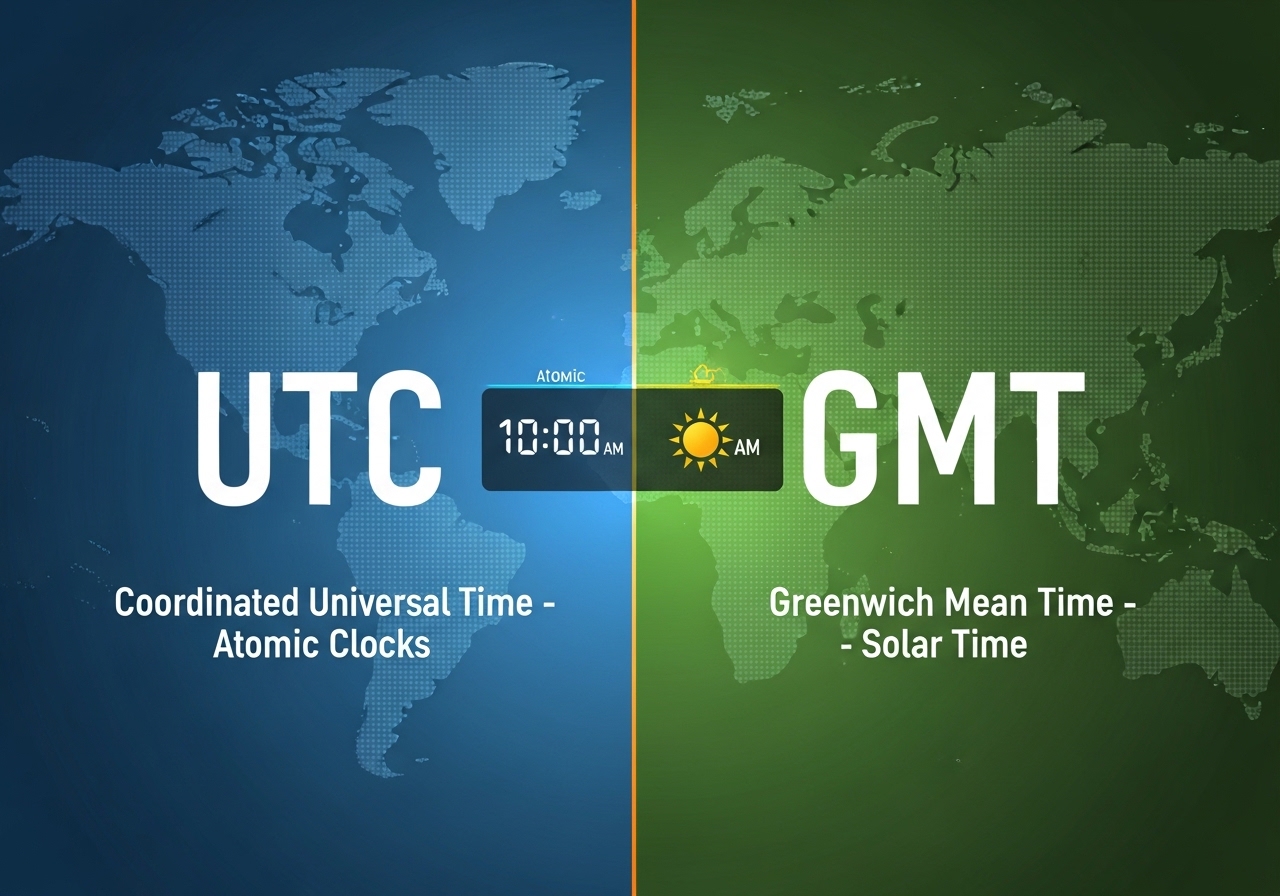
Why UTC and GMT are Quite the Same Yet Very Different
Here’s why most people today use UTC instead of GMT: Coordinated Universal Time (UTC) is preferred over Greenwich Mean Time (GMT) primarily because the former is a more precise, scientifically based standard that remains consistent year-round, whereas GMT is a time zone subject to seasonal changes. While they are often used interchangeably because they share the same base time (+0), UTC is the standard for modern, technology-driven, and global applications.
Here are five cogent reasons why UTC is preferred:
1. Superior Precision (Atomic vs. Solar Time): GMT is Solar-Based: Historically, GMT was based on the rotation of the Earth and the position of the sun at the Greenwich meridian. The reference to ‘Greenwich’ is because longitude 0° historically passed through the Royal Observatory in Greenwich, London established in 1884. (Technically the line is now 102 metres away.) Because the Earth’s rotation is not perfectly uniform (it slows down slightly), GMT lacks the microsecond precision required for modern technology.
UTC is Atomic-Based: UTC is calculated using atomic clocks, which are incredibly precise. This makes UTC essential for GPS, satellites, international telecommunications, and computer networks.
2. Consistency (No Daylight Saving Time); UTC never changes: UTC does not observe Daylight Saving Time (DST). It remains at +00:00 all year.
GMT shifts: In the UK, time shifts between GMT in the winter and British Summer Time (BST) in the summer. Using UTC avoids the confusion of switching between GMT and summer time.
3. Scientific and Global Standard Universal Reference: UTC is the international standard used to regulate clocks and time globally. It acts as the anchor for all other time zones (e.g., UTC+1, UTC-5), making it more neutral and universal than a time zone named after a specific location.
Aviation and Military: Known as “Zulu” time, UTC is the standard for aviation and military operations to avoid confusion across different time zones.
4. Technical Reliability Leap Seconds: To keep UTC aligned with the Earth’s slightly irregular rotation, leap seconds are added, allowing it to maintain the extreme precision of atomic time while remaining in sync with the sun’s position within one second.
5. Decolonization: Longitude 0° (Prime Meridian) passes through many wonderful places in the world, including Tema in Greater Accra, Ghana, not just a certain Greenwich, London in the United Kingdom. Giving such a globally central phenomenon a universal tag (UTC) is much more appropriate in our modern world.
In short: While GMT is still used in the UK and in casual contexts, UTC is preferred because it is scientifically precise, consistent, independent of political or regional time changes and is free of colonialism vibes.